
 Login
Login
Why filter identification still needs real expertise.
 11th September 2026
Holm Education
11th September 2026
Holm Education
AI is everywhere, saving time for many people.
At Holm, we’re encouraging our staff to use AI to aid them in their office and operational processes, brainstorming, researching, summarising... Safe to say, we use it where we can, and we’re not the only ones.
In fact, an interesting idea came from one of our clients the other day. They wanted to know if filter identification can be done by AI.
The short answer is: to a point.
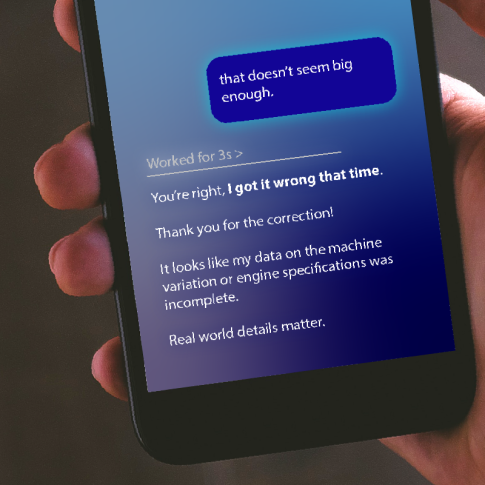
But, as with any use case, AI is only as good as its prompt and the data it has access to. AI can give you generic information which will bring you a lot closer to identification but here’s a few points to watch out for:
- Machine variations – this could be anything from the boom length which would affect the hydraulics to whether it has a cab or not (which would indicate whether or not you need cabin air filters).
- Engine specs – tier 3, 4 or 5 engines are the most common we come across, which all have different filters. But then you also get the different engine manufacturers within each machine manufacturer.
- Serial breaks – machines built to different specs depending on when they were built and what the specs were at that point.
- Incomplete data – For example if filter housing has been replaced with a different one post-warranty, or if the engine spec is no longer the original.
When it comes to identifying the correct filter, anyone who has serviced the machine for a few thousand hours will often be able rattle it off the top of their head. But that experience doesn’t live within AI naturally. You can train AI with specialist information and experience, but that knowledge doesn't just appear there by itself.
The problem isn't that AI can't find filter information. The problem is knowing whether the information it finds actually applies to the machine in front of you.
That’s why we’ve made it as simple as we can using the Holm Filter Finder.
AI might tell you “these three filters are associated with this machine.”
Holm helps to establish that “this is the one you actually need.”
Accuracy is what we pride ourselves on. The Holm Filter Finder is powered by data from real people who have been in the parts industry, specialising in filters for years. Every day, more data is checked and added in, helping us build one of the most comprehensive sources of filter data for the construction industry.
AI has its place. We’re using it ourselves.
But when the difference between the right filter and the wrong filter comes down to machine variations, engine specs, serial breaks and the data you have available, real expertise is still essential.
Not sure which filter you need?
Try the Holm Filter Finder, or give one of our filter experts a call on 01403 914400.